
Key takeaways
- The most commercially resilient stores in the global department store sector — Harrods, Liberty London, Bergdorf Goodman, Le Bon Marché Rive Gauche — have never expanded beyond a single address.
- Retail expansion does not guarantee strength. Barneys New York grew to 22 locations before filing for Chapter 11 bankruptcy in 2019. Selfridges explained and held its identity. Ther difference? What the brand is made of in the first place.
- An iconic address is a starting point. La Samaritaine had the location, the history and a €750 million restoration, and still lost its customer. Case in point: staying in one place is not enough. What you do there is everything.
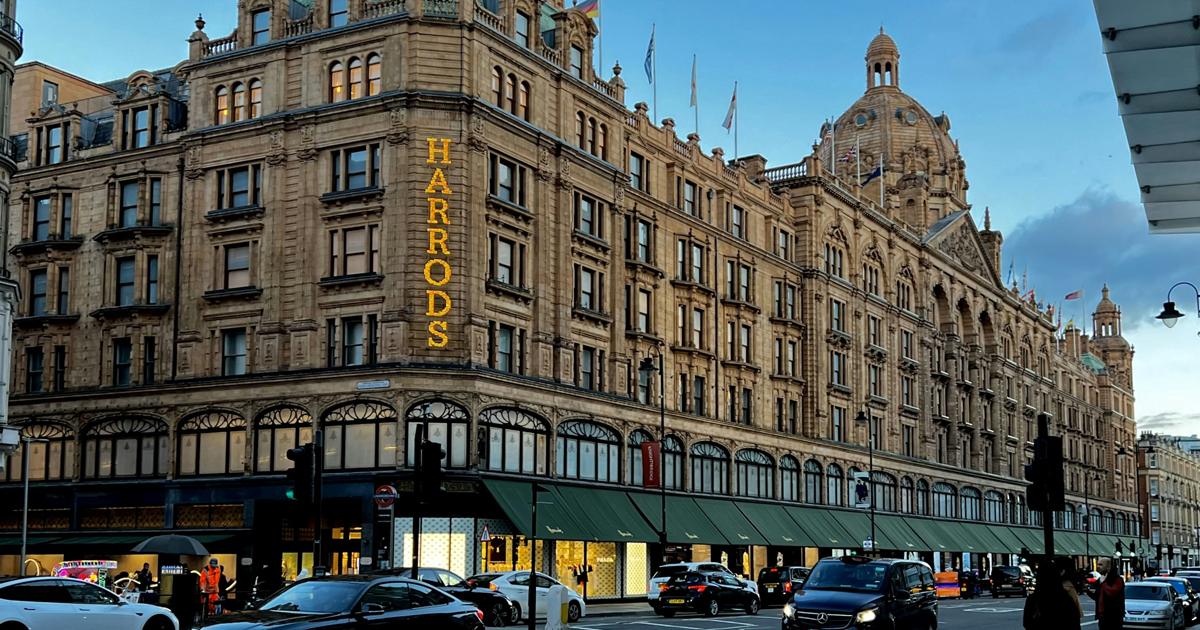
The conventional logic of retail expansion is hard to argue with on paper. More doors mean more revenue, more market presence, more leverage with brand partners. Especially when you consider that the entire architecture of modern retail has been built around scale. Yet some of the most commercially durable stores in the world — Harrods in Knightsbridge, Liberty London on Regent Street, Bergdorf Goodman on Fifth Avenue, Le Bon Marché Rive Gauche on Paris’s Left Bank — have never expanded beyond a single address. So why haven’t they? Is that restraint a limitation they have worked around, or the foundation of their department store strategy altogether?
The answer, the evidence suggests, is the latter. But it comes with one condition.
Does staying in one place really work as a department store strategy?
The financial case for single-location retail is stronger than it looks. Harrods reported turnover of £1.08 billion for the 52 weeks to February 2025. Α “stable trade,” in the words of Managing Director Michael Ward, that represented outperformance of the luxury industry during a year when global luxury spending declined. Liberty London posted flagship store sales of £75.4 million for the 52 weeks ended 3 February 2024, up 15.1% year-on-year, with a return to pre-tax profit after years of post-pandemic recovery. Both figures come from a single building — both in London.
The argument is not simply that these stores have survived. It is that their address is inseparable from what they sell. Liberty London’s Tudor Revival building, completed in 1924, is itself part of the product. The same applies to Bergdorf Goodman’s Beaux-Arts building at 58th Street and Fifth Avenue, which Edwin Goodman built in 1928 and deliberately chose not to replicate. When a Chicago branch was proposed in 1965, it was cancelled two years later. Goodman’s operating philosophy was that quality of merchandise and service could only be maintained where he could personally oversee it.
But restraint is not the only path forward. The more instructive question is what happens when stores do expand, and why some survive it while others don’t.
The expansion predicament
Barneys New York is the clearest answer in the department store sector. Founded in 1923 as a single downtown Manhattan store, Barneys built its identity around a specific curatorial point of view: avant-garde, fashion-forward, deeply rooted in a particular idea of New York. It worked precisely because it was singular. As the business pursued retail expansion, growing to 22 locations including 12 warehouse off-price outlets, that singularity dissolved. The store that had ONCE been described as a three-dimensional glossy magazine became a chain. By August 2019, it had filed for Chapter 11 bankruptcy. All stores closed by 2020.
The diagnosis from retail analysts at the time was blunt: a department store strategy built around taste-making cannot scale without destroying the taste.
Selfridges tells a different story. And it is worth examining why. The Oxford Street flagship opened in 1909. By 2003, it had expanded to four locations across London, Manchester, and Birmingham. The expansion worked because each location was architecturally distinctive — the Birmingham store, designed by Future Systems and clad in 15,000 aluminum discs, has been named one of the world’s top 100 stores to visit every year since it opened — and because the brand’s identity was resilient enough to travel. Selfridges was never built around a single neighborhood or a single curatorial voice. It was built around pure, inspiring spectacle.
Location, location, location?
No. And this is where the argument becomes more demanding. Geographic and cultural specificity creates the conditions for authority, but does not necessarily guarantee it. A store at a great address with a famous history still must earn the reason for the visit, every year.
La Samaritaine on the banks of the Seine had been part of Parisian life since Ernest Cognacq opened it in 1870. When LVMH acquired a majority stake in 2001, the store had already been losing relevance for decades. After a closure in 2005 and a €750 million restoration by Japanese, Pritzker Prize winning architecture firm SANAA it reopened in June 2021 as a luxury emporium operated by DFS, LVMH’s duty-free arm. The architecture was extraordinary. The customer relationship that five generations of Parisians had built with “La Samar,” a store where locals bought light bulbs alongside dresses, was gone. The building survived. Sadly, the institution did not.
The contrast with Merci is instructive. Founded in March 2009 by Bernard and Marie-France Cohen — the founders of Bonpoint — at 111 Boulevard Beaumarchais in Paris’s Haut-Marais district, Merci operated as France’s first magasin solidaire, donating profits to educational projects in Madagascar. It transformed a neighborhood that people had previously passed through without stopping. In 2013, the Cohens sold Merci to HGD, the family holding company of Gérard Darel founders the Gerbi family. The store’s values held. In March 2025, Merci opened a second address at 19 rue de Richelieu, in a former post office vacant for over a decade. This was no opportunistic scaling. The rule the new owners set for themselves was explicit: the second location could and would not be a replica. Different building, different neighborhood energy, same values.
What does staying in one place require
What do those department stores mentioned have in common? They kept finding new reasons for people to make the journey. Liberty London’s own-brand products now outperform third-party brands, a direct investment in what Liberty alone can offer. Harrods continued to invest in its Knightsbridge store through a year of flat turnover, redeveloping womenswear spaces and renovating The Georgian restaurant. Le Bon Marché Rive Gauche, under LVMH ownership, built its retail strategy around continuously renewed cultural programming and a differentiated product selection rather than format replication. Bergdorf Goodman’s window installations function as public art, a free, recurring reason to visit the Fifth Avenue location regardless of purchasing intent.
Staying in one place is not a department store strategy in itself. What you do there is.


