
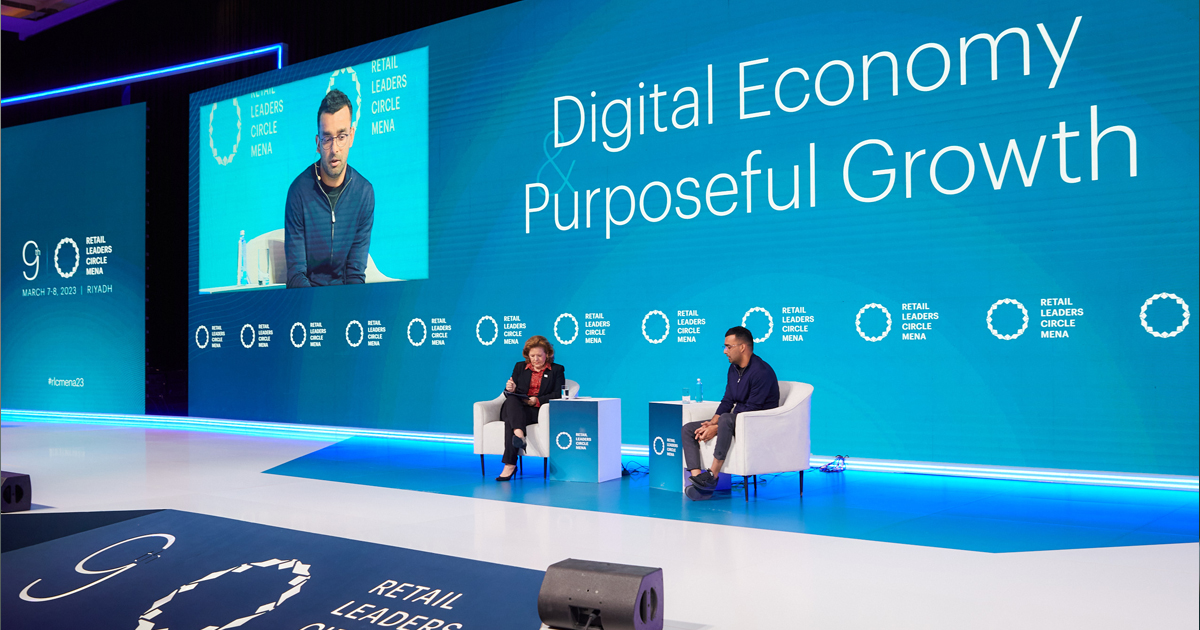
In only five years, noon has emerged as the premier online retailer in the Middle East, a home-grown brand that meets the needs of consumers for convenient access to the products they love. But the growth has not been without challenges. In his discussion with Eithne Treanor, Founder & CEO, E Treanor Media, Faraz Khalid, CEO of noon, reflected on the company’s growth journey and the transformations required to meet its goals.
Eithne Treanor: What is driving noon’s growth across Saudi Arabia, the UAE and Egypt?
Faraz Khalid: At the heart of it is this fierce ambition to be the home screen for the region. We want shopping journeys to start with us, and we want to connect every single SKU and unit of inventory in our warehouses or with retailers around the region, providing a seamless connection to customers through our delivery service.
We really believe that retail as we know it will fundamentally change. The North Star for us is what you see in South Korea, where e-commerce penetration is about 40%. It is the most advanced e-commerce market in the world. If you go to Seoul, it is remarkable what they have been able to achieve, particularly in bringing grocery shopping online in a very meaningful way. Grocery has traditionally been a lagging category in e-commerce.
I really believe that our region is uniquely placed to capture that opportunity. If you look at the mobile phones people are using, the average age of a device on our platform is about 19 months. Everyone has a fast, new phone. We have 5G connections and very high GDP per capita, combined with emerging-market economics as far as costs are concerned. We are at an incredible inflection point where people will increasingly ask themselves: if something can be delivered reliably and at a convenient speed, why should they drive across town to buy it?
That is what we are building towards. It takes a lot of time. You cannot do this in two or three years. I feel it is a multi-decade build, and you need to have that patience and sense of mission.
ET: How is noon making 15-minute delivery commercially viable?
FK: We really believe that value is not the only thing that drives customer preference. We have tried many approaches, including core e-commerce, which covers everything outside grocery and fresh products. We have been in that business for five years, and we believe we have built strong foundations to scale it. But we tried and failed multiple times on the grocery front. In Riyadh, we had a large warehouse outside the city with 30,000 SKUs, offering next-day delivery. We simply did not see the kind of adoption you see in Korea.
You have to approach the problem in different ways and figure out how to get customers to say that this is more convenient than the way they currently shop. That is where the 15-minute delivery model came from.
ET: What are the biggest challenges facing delivery operations?
FK: Bikes are generally challenging. Even in Dubai, the accident count is pretty high, and everyone knows that. Our goal has shifted this year. Of the many challenges we need to address, we want to become a rider- and driver-oriented organisation. They are the real frontline of e-commerce. They are the real frontline of retail, and for years they have been ignored. Everyone has been focused on ramping up capacity without really thinking about the people doing the work. When a delivery driver calls to ask for an address, people often get annoyed. Some even shout at them. It is heartbreaking. A number of our leadership team are tasked with making deliveries every week. When we do that, we experience the same challenges. A driver is simply trying to find the customer’s apartment and deliver the package.
We need to understand what that driver goes through. They have to find parking, carry packages across courtyards in 50-degree heat and sometimes deal with customers who do not answer their calls. We have to find a way to build empathy and develop technology that supports both parties. Beyond that, as industry players, we need to encourage regulators to think seriously about these people. There are going to be hundreds of thousands of drivers in each city. Our own fleet already consists of tens of thousands of drivers. I cannot imagine a scenario where e-commerce continues to grow without a fundamental shift in the way we treat these people.
ET: What does the acquisition of Namshi mean for noon’s fashion ambitions?
FK: We had an opportunity when Namshi’s shareholders were looking to dispose of the asset. Through that process, noon was able to engage and bring it back. We really believe Namshi is an iconic, generational company. It was the first real breakthrough platform for fashion in the region. The market has evolved considerably, particularly with value fashion and cross-border commerce, but Namshi was the original player. Its customer franchise remains robust, and it is by far the leader in branded fashion in our region. We are very proud to have it back.
Hisham Hossam and I spent about six years building that company, and we felt there was so much soul in the business that could be turbocharged by noon’s infrastructure.
We are now injecting noon’s supply chain, technology platform, payment systems and a large part of our customer franchise into the business. Hopefully, Namshi can become the company it always promised to be. We really believe it will be the fashion champion for the region.
ET: Why is noon expanding into entertainment and gaming?
FK: What surprised us is the size of our customer franchise. The percentage of the population that comes onto the app every day is truly spectacular, and it has exceeded our expectations. What we are trying to do is build services that are relevant to the audience we already have. We have launched food delivery in the UAE and are preparing to launch it in Saudi Arabia. We have launched grocery, we have 15-minute delivery, and we have our core e-commerce platform.
Beyond that, during the World Cup, we noticed the growing trend of sports gaming around the world. So we launched Golazo, a sports prediction game where users could guess the score of a football match. Twenty-two million people interacted with the game during the World Cup. On average, about a third of our audience was making predictions every day. That told us something.
We subsequently acquired the rights to the Indian Premier League, one of the most exciting cricket tournaments in the world, and are preparing to launch a sports streaming service at the end of March. It is not relevant to everyone, but for people from South Asia, cricket is an enormous part of their lives for two months of the year.
We also introduced rewards into the prediction game. If users correctly predict a number of scores, they win medals, which can be converted into shopping credits on noon.
ET: What are noon’s priorities for the next two years?
FK: Our North Star is very clear. We want to remain extremely focused on the fundamentals and deliver the ultimate convenience platform for our region. Nothing fancy, nothing shiny. We just want to make sure that if you order something, we can bring it to you at the cheapest delivery fee and in the fastest possible time. It is not very glamorous, but it is very, very hard.
The next 24 months are going to be about that.
 We want to be the engine of efficiency and convenience for our region. We want to inspire people by what we build and how we build it. And that’s actually super important for us because we will always be the insurgents.


