
Key takeaways
- Frasers Group acquired Harvey Nichols in August, through a pre-pack administration for a reported £40 million, thus ending 35 years of ownership under Hong Kong billionaire Dickson Poon.
- The six-store UK estate is unlikely to survive intact; the more probable outcome is a luxury proposition concentrated around the Knightsbridge flagship, with weaker stores absorbed into other Frasers fascias.
- Whether the luxury brands currently in Harvey Nichols will remain under new ownership is the question the industry is watching most closely.
I was lounging in the French countryside, contemplating the merits of another dip in the pool, when the news landed on my phone: Frasers Group had acquired Harvey Nichols. I read it once, put the phone down, and picked up my book. Was I surprised? Not really. After weeks of speculation, everyone knew this day was coming.
On August 13, 2026, Mike Ashley’s Frasers Group announced that it had purchased Harvey Nichols through a pre-pack administration, a deal structure that lets a buyer take the assets and walk away from the liabilities before the business formally enters insolvency. The price, according to the Financial Times and unconfirmed by Frasers, was approximately £40 million — a sobering figure for a 195-year-old British institution that once defined what it meant to shop in style.
What it means for luxury retail, for the brands, the stores, and the idea of who gets to protect them, well, that is the more interesting question.
This didn’t happen overnight
Harvey Nichols had not been in good shape for some time. The British luxury department store reported an after-tax loss of £105 million for the fiscal year that ended March 2025, driven largely by the impairment of intragroup loans, but symptomatic of a deeper commercial problem. Its executives had already warned that the business could not continue without new financing. When none materialized from existing ownership, administration followed.
Yet everyone — myself included — still remembers what Harvey Nichols was in the 1990s and 2000s: a name that had become a synonym for taste and exclusivity; its Knightsbridge flagship genuinely covetable; a store people actually dressed up to visit, where the carrier bag alone carried a certain weight (pun intended). For the past decade, it had been losing ground and losing money.
Ashley’s own words were also telling. He told the Financial Times he wouldn’t pay more than £40 million for what he described as being in a “death spiral.”
And this is not Frasers’ first distressed luxury acquisition. In 2023, the Group bought Matchesfashion, the luxury e-tailer many had already written off, for approximately £52 million. It was in administration within months.
The real asset
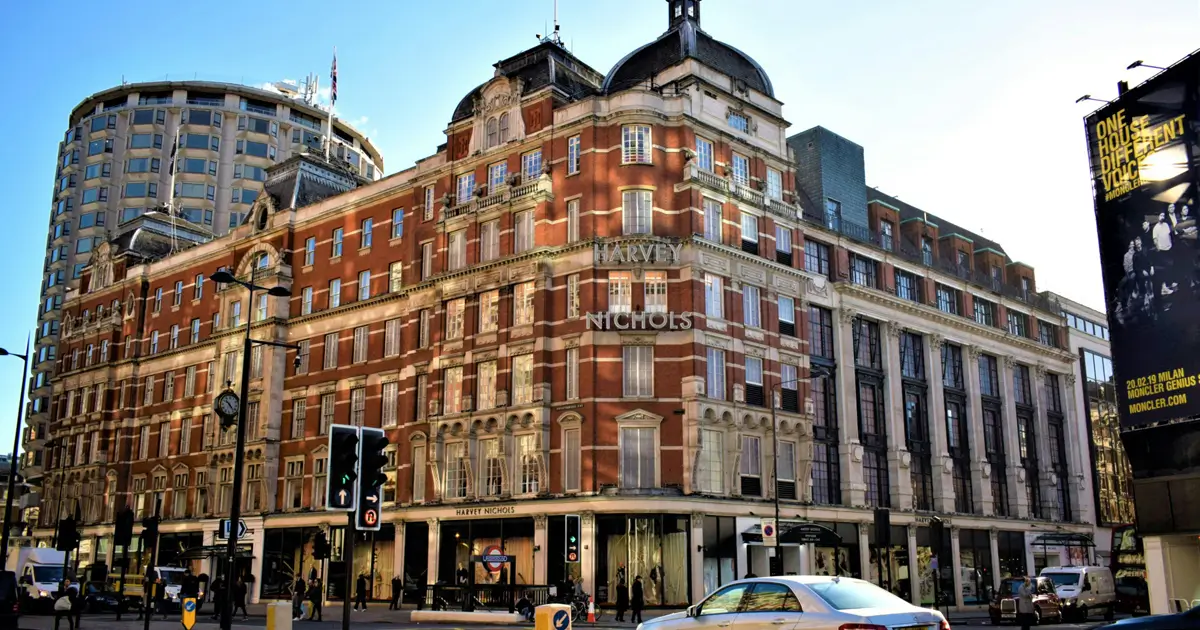
Strip away the branding and what Frasers Group acquired in reality is a Knightsbridge address, a portfolio of brand relationships, and a name that still carries some weight — just about. The six-store UK estate is another matter entirely. My guess is that most of it will not survive long under new ownership, a view Louise Deglise-Favre, lead apparel analyst at GlobalData, shares: the probable outcome is a luxury proposition concentrated around Knightsbridge, with the weaker stores absorbed into House of Fraser or Flannels.
Nowadays, large-format, multi-floor luxury retail has become an extraordinarily expensive proposition, with high rents, high staffing costs, and a customer who increasingly prefers walking into a mono-brand flagship or shopping from a phone. Barneys New York is gone. Neiman Marcus filed for bankruptcy and has spent years trying to find its footing. Debenhams is also gone. Harvey Nichols is now part of a sports retail empire. Believe me, these are not isolated events. But that is a conversation for another day.
What survives in Knightsbridge will survive because the address still carries genuine weight among the fashion cognoscenti; the editors, buyers, and brand directors for whom a Harvey Nichols concession still means something. That cultural currency is real. Whether Frasers Group knows how to spend it is a different question entirely.
Do the brands hold all the cards?
Here is what the deal, in my opinion, does not guarantee: that the luxury brands currently in Harvey Nichols will stay after the transition.
Luxury retail operates predominantly on a concession basis. Gucci, Prada, Dior, Moncler, are not tenants. At least not in the traditional sense. They can withdraw quickly, at limited cost, the moment they decide the environment no longer suits them. In the luxury market, context is everything, and ownership is part of that context.
Frasers has been signaling its luxury ambitions for quite some time now, deepening relationships with Gucci, Burberry, and Prada, acquiring stakes in Mulberry and Hugo Boss, building out Flannels as a premium proposition. The elevation strategy, as Murray calls it, is real and deliberate. Whether the luxury houses see it the same way is something we will find out gradually, brand by brand. Harvey Nichols, at its best, was a destination they chose. The opportunity for Frasers is to make it one they will choose again.
The custodian question
There is, however, a dimension to this story that goes beyond real estate and brand contracts. Harvey Nichols has always been something more than a simple retailer. It was a gatekeeper, a name that decided what belonged in its rooms and what did not. That curatorial authority was part of its value to brands and customers alike. Harvey Nichols helped confer relevance, context and credibility.
And I cannot ignore that the Group is genuinely trying to change its identity through a deliberate elevation strategy, backed by a multi-year pattern of investment. But curation is not the capability on which Frasers built its reputation. Its identity was built on scale, acquisition, operational discipline and an ability to buy distressed assets and integrate them into a sprawling portfolio. That is a legitimate business model. It is just a different one.
There is precedent for the optimistic scenario. When Qatar Holding acquired Harrods in 2010, the question was whether new ownership could preserve the identity and authority of one of the world’s best-known luxury department stores. The new owner invested heavily in the business, the store and the customer experience without diminishing the distinctiveness of the Harrods name. If anything, the institution emerged stronger.
The luxury retail industry has spent years wrestling with questions of dilution. What happens to a brand when the dream becomes too accessible, when the price goes up but the feeling does not? The Harvey Nichols acquisition adds a new version of that question: what happens to luxury retail when stewardship passes to an owner whose core expertise lies in acquisition, restructuring and scale?
I do not have the answer. Nobody does yet. What happens next is a calculated bet: whether an owner built for turnarounds can become a guardian of something far more intangible.


