
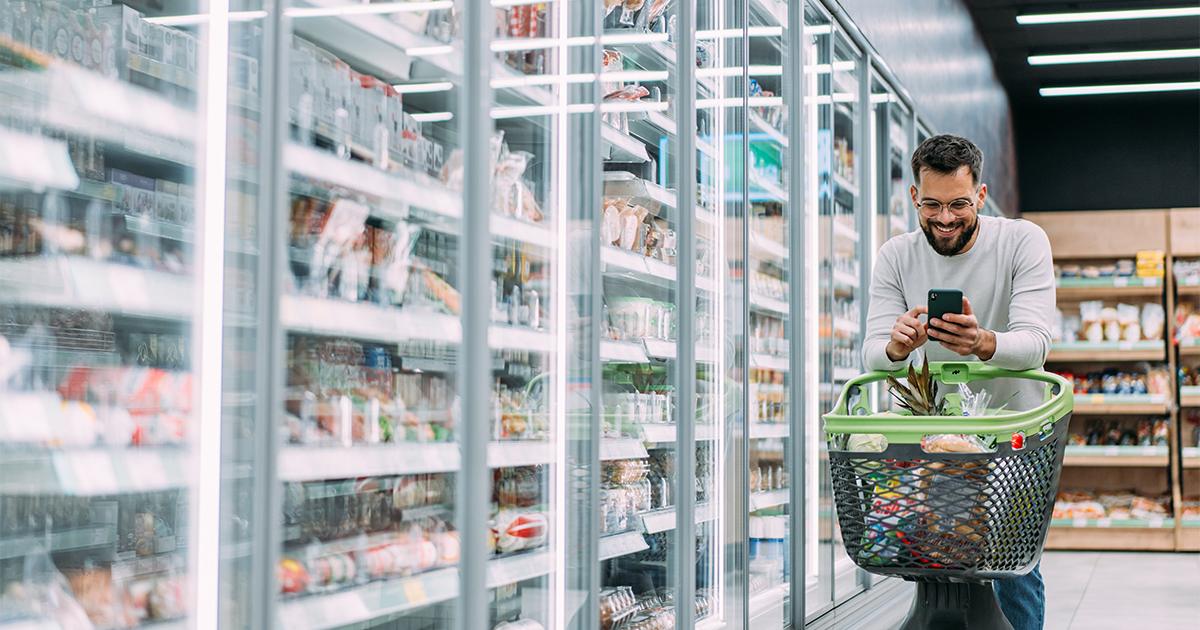
The grocery retail game is changing, but now it’s changing in real time. In March 2025, U.S. grocery and beverage spending reached an estimated $79.2 billion, marking a 3.05% increase year-over-year, according to the CNBC/NRF Retail Monitor. But while spending is up, the battleground has shifted. Shoppers now flow seamlessly from screen to store, and loyalty depends more on convenience than brand. Hybrid grocery is a thing. And it’s growing every day.
Brick-and-mortar stalls, e-commerce accelerates
Online grocery just had a flashback to 2020—but this time, it’s by choice. In March 2025, Americans spent $9.7 billion on groceries online, a 21% leap from the year before, according to a survey by Brick Meets Click and Mercatus. Even more telling? 57% of U.S. households shopped for groceries online, matching the all-time highs of the early pandemic.
What does that say? Today’s shoppers expect a handoff between app and aisle that feels frictionless, fast, and familiar. And they don’t care where the transaction happens, as long as it works.
Even in markets like Saudi Arabia, the e-commerce momentum is impossible to ignore. As Abdel-Salam Bdeir, CEO of SACO, remarked on his company’s digital transformation strategy during the 2025 RLC Global Forum in Riyadh: “In this market, brick and mortar is practically stagnating and all the growth is coming from E-com… Zero operational issues. Merchandizing layouts, shelf tags, customer complaints, all that is out of the way.”
For retailers, this means building the operational and technological muscle to perform at full strength and on every front, all the time. It means creating a hybrid grocery model.
Assortment meets intelligence
In-store, shelf space is finite. Online, it’s infinite—and dangerously tempting for that matter. But retailers like Tamimi Markets are learning that more SKUs don’t equal more sales. Instead, it’s about the right assortment, the right price, and the right fulfillment. As Bdeir emphasized, throwing AI at bad data or outdated inventory is a fool’s errand: “If you replenish that, you’re going to be replenishing a problem.”
At Ocado, innovation is… surgical. What once took 74 minutes of labor to fulfill now takes just 7.5, thanks to two decades of obsessive investment in automation. That kind of performance doesn’t happen by chasing volume. It comes from building smarter systems that respect both cost and complexity.
After all, in the hybrid model, efficiency doesn’t come from doing everything. It comes from doing only what works and doing it exceptionally well.
Engineering the customer experience
But delivering on that expectation isn’t just about one-to-one marketing emails or product recommendations—it’s about system-wide orchestration: aligning people, platforms, data, and decisions in real time.
According to KPMG’s 2024–2025 Customer Experience Excellence Report, the companies that lead on customer experience are those that deliver connected journeys. And what separates top performers is consistent execution across every touchpoint, from digital interfaces to frontline staff. In grocery, this means getting the basics right: fast checkout, reliable stock, helpful support, and clear communication—every time.
Meanwhile, Deloitte’s 2025 U.S. Retail Outlook found that 70% of retail executives are prioritizing AI to reduce wait times, personalize promotions, and anticipate needs before a cart is even filled. In other words, experience is now embedded into logistics, inventory systems, and frontline operations.
Customers can’t and won’t distinguish between digital and physical missteps. A broken search function or an out-of-stock staple triggers the same reaction as a rude cashier. Precision matters. So does empathy. And in grocery, both need to be built into the system, not layered on top.
The weakest link: Organizational structure
Adriano Araujo of Ocado made it plain: too many grocery leaders are still asking, “How can AI help me?” when they should be asking, “What problem am I solving?” That shift—from chasing tools to solving real problems—requires something more than plain strategy. It demands a reset in how decisions are made.
Legacy chains often reward consistency and process over experimentation. But hybrid grocery isn’t static. It evolves by testing, adjusting, and iterating—fast. For brands that are serious about agility, missteps are signals to adjust course.
What makes that work? People. At SACO, for instance, platform improvements are jointly owned by IT, e-commerce, and logistics. That structure forces alignment and accelerates execution. And when teams move in sync, the tools finally start to deliver.
Because hybrid grocery doesn’t need more dashboards. It needs more minds at the table, solving the right problems. Together.
The new shelf space is digital
The grocery battle is increasingly shifting from the frozen aisle and produce bins to app interfaces, fulfillment centers, and customer data dashboards.
According to KPMG, personalization now accounts for over 20% of what determines customer loyalty—more than any other factor. In a category where margins are thin and switching is easy, the ability to dynamically tailor the offer is becoming a core competency.
And this isn’t a future-state scenario. Hybrid grocery is already shaping what gets seen, what gets sold, and who stays loyal.


