
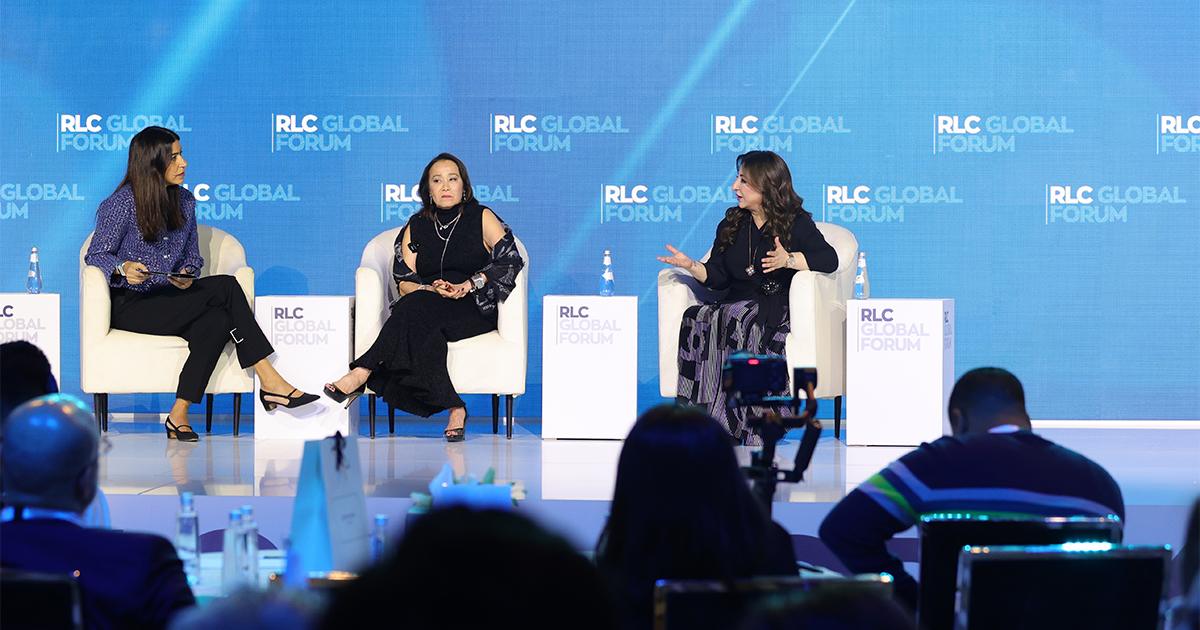
Leadership in today’s fast-changing business landscape requires more than just strategic thinking and operational expertise—it demands agility, emotional intelligence, and the ability to foster innovation while staying true to core values. Women in leadership are increasingly proving that success is not about following traditional corporate structures but about reshaping leadership models to reflect the evolving expectations of both employees and customers.
This was the focus of Women Who Lead: Redefining Leadership, Innovation, Impact, a powerful conversation at the 2025 RLC Global Forum, featuring Sima Ganwani Ved, Founder and Chairwoman of Apparel Group, and Supaluck Umpujh, Chairwoman of The Mall Group, and moderated by Hala Zgeib, Head of Luxury at Snap Inc.. These accomplished leaders brought to the table decades of experience across global retail, offering nuanced insights into what it takes to lead in today’s world.
Together, they explored how consumer behavior is shifting and how companies must rethink their strategies to remain competitive. This was not a discussion about gender representation, but rather a deep dive into leadership philosophies, the intersection of innovation and purpose, and the future of customer engagement through a new lens of influence and authenticity.
A New Leadership Mindset: Vision, Empathy, and Purpose
Modern leadership is not about power or control but about guiding organizations through complexity with vision, purpose, and resilience. Many leaders no longer see themselves as just decision-makers but rather as problem solvers, culture builders, and facilitators of innovation. Effective leaders must inspire trust and trust is built through transparency, consistency, and a leadership style that empowers teams rather than micromanaging them. Employees who trust their leaders are more likely to embrace change, take initiative, and contribute to an organization’s long-term success.
Another defining characteristic of modern leadership is agility. Leaders must be fast learners, adaptable to market shifts, and willing to evolve their strategies in response to consumer and industry trends. The old model of top-down decision-making has given way to collaborative, insight-driven leadership, where team members contribute ideas and leaders serve as guides rather than enforcers.
The Changing Consumer Landscape and the Need for Innovation
The modern consumer expects more than just products or services, they seek experiences, convenience, and brands that align with their values. Retail is seeing rapid shifts in purchasing behavior, with consumers increasingly expecting instant gratification, seamless digital experiences, and high levels of personalization.
Companies must continuously evolve their customer engagement strategies to stay relevant. Businesses that fail to adapt will be left behind in a world where speed and innovation dictate success. The expectation for fast delivery, frictionless online shopping, and omnichannel retail experiences means that companies must integrate technology, data, and AI into their operations. The most successful brands use technology to enhance relationships, not replace them, ensuring that consumers feel valued rather than treated as just another data point.
Standing Out in a Crowded Market: The Power of Differentiation
The retail sector is becoming increasingly crowded and competitive, making it imperative for brands to offer something truly unique. One of the most effective strategies for differentiation is creating an emotional connection with customers. Brands that invest in unique experiences, storytelling, and personalized engagement see higher levels of customer loyalty. A major insight was that great brands are not built on discounts or short-term promotions. They are built on strong emotional connections with their customers. Leaders who embrace bold, innovative ideas and execute them with conviction are the ones shaping the future of their industries.
Technology and AI: A Tool, not a Replacement
The rise of AI and digital transformation has reshaped how businesses operate, optimize supply chains, and engage with customers. Retailers are increasingly leveraging AI-driven analytics to optimize pricing, inventory management, and customer insights, allowing them to stay ahead of trends and anticipate customer needs before they arise. However, technology should not come at the cost of human interaction, as emotional intelligence and empathy remain key differentiators in customer relationships. The best companies blend innovation with human-centric leadership, ensuring that automation and AI work alongside employees rather than replacing them.
Key Statistics
- Retailers investing in omnichannel strategies have reported a 25% growth in revenue, proving that seamless integration between online and offline channels is essential.
- Companies with purpose-driven leadership experience 35% higher employee retention, reinforcing the importance of a strong workplace culture
“Technology is evolving at a rapid pace, but the one thing it can’t replace is human emotion. Genuine connection and purpose are what make great leaders and great brands stand out.”
– Sima Ganwani Ved
Lorem ipsum dolor sit amet, consectetur adipiscing elit. Ut elit tellus, luctus nec ullamcorper mattis, pulvinar dapibus leo.
Lorem ipsum dolor sit amet, consectetur adipiscing elit. Ut elit tellus, luctus nec ullamcorper mattis, pulvinar dapibus leo.


